 Best Fencing Charlotte
If you have a wood fence in Charlotte, you have probably seen warped boards. Maybe one or two pickets bow outward. Maybe an entire section looks wavy instead of straight. Warping is the most common complaint Charlotte homeowners have about wood fences, and the reason is simple: our summers are brutal on wood.
The good news is that most warping is preventable. The bad news is that once a board is badly warped, there is no magic fix to make it flat again. The best approach is to understand why warping happens, take steps to prevent it during installation, and maintain your fence properly so it stays straight through Charlotte's worst summer months.
Why Charlotte Summers Cause So Much Warping
Wood warps when it absorbs moisture unevenly. One side of the board gets wet while the other side stays dry, or the board soaks up water and then dries out too fast. The wood fibers expand and contract at different rates on different parts of the board, and the result is a curve, bow, twist, or cup.
Charlotte's summer weather is almost perfectly designed to cause this. Here is what a typical July week looks like for your fence:
- Morning humidity at 85% to 95% -- the wood absorbs moisture from the air
- Afternoon temperatures hit 95 to 100 degrees -- the sun-facing side of the fence dries rapidly while the shaded side stays damp
- A late afternoon thunderstorm dumps an inch of rain in 30 minutes -- the fence gets soaked
- The next morning, full sun returns and the cycle starts over
These rapid wet-dry cycles are the enemy of flat fence boards. The wood never reaches a stable moisture content. It is constantly expanding and contracting, and over the course of a Charlotte summer, that repeated movement forces the boards out of shape.
The problem is worse on south-facing and west-facing fence sections, which get the most direct sun exposure during the hottest part of the day. If you look at a fence with warped boards, the worst sections are almost always the ones facing the afternoon sun.
Which Wood Warps the Most?
Not all wood warps equally. The species, the cut, and the grade all affect how much a board is likely to warp.
Flat-sawn pressure-treated pine warps the most. This is the standard fence board you find at most lumber yards and home improvement stores. Flat-sawn boards have growth rings that run roughly parallel to the face of the board. When the board absorbs moisture, those rings expand unevenly, pulling the board into a cup or bow shape. Since most budget fencing uses flat-sawn pine, this is the material you see warping most often on Charlotte fences. For a deeper comparison of wood options, read our cedar vs. pressure-treated pine guide.
Vertical-grain cedar warps the least. Vertical-grain (also called quarter-sawn) lumber has growth rings that run perpendicular to the face of the board. This grain pattern resists cupping and bowing because moisture causes more uniform expansion. Cedar also absorbs less water overall than pine because of its natural oils. The combination of good grain orientation and natural moisture resistance makes vertical-grain cedar the most warp-resistant fence board available.
Standard-grade cedar falls somewhere in the middle. It is better than pine because cedar is naturally more stable, but standard-grade cedar is usually flat-sawn, which means it is still susceptible to some warping in extreme conditions.
Board Thickness and Width Matter
The physical dimensions of your fence boards affect warping significantly.
Thickness. Most standard fence pickets are 5/8 inch thick. This is the minimum thickness for a privacy fence board, and it is also the most warp-prone. Thicker boards -- 3/4 inch or 1 inch -- resist warping much better because they are stiffer and the moisture gradient from one face to the other is less extreme. If you are building a new fence and warping concerns you, spending the extra money on 1-inch-thick boards pays off over time.
Width. A 6-inch-wide board warps more than a 4-inch-wide board, all else being equal. Wider boards have more surface area for uneven moisture absorption, and the wider face gives the warp more room to express itself. Narrow boards stay flatter. This is one reason that board-on-board fences with narrower, overlapping pickets tend to look straighter than stockade fences with wide, butted-together boards.
Installation Mistakes That Cause Warping
Even good wood can warp badly if the fence is installed wrong. Here are the installation errors that cause the most problems in Charlotte:
Not leaving gaps for expansion. Wood expands when it absorbs moisture. If the pickets are installed tightly butted against each other with zero gap, they have nowhere to go when they swell. The boards push against each other and warp outward. A good installer leaves a 1/8-inch to 1/4-inch gap between boards to allow for seasonal movement. In Charlotte's humidity, this gap is not optional -- it is necessary.
Nailing too tightly. Over-driven nails pin the board rigidly at the fastener points but leave the rest of the board free to move. This creates stress points where the board is forced to bend around the nails. The result is a board that warps between the nail locations, creating a wavy pattern.
Using green or wet lumber. Freshly milled pressure-treated pine is often still saturated with moisture when it arrives at the job site. If you install it immediately, the boards will shrink as they dry out over the next few weeks, and that shrinkage will not be uniform. Some boards twist, some bow, and some cup. Letting the lumber acclimate to the local air conditions before installation reduces this dramatically.
Skipping sealant. A new wood fence that is not sealed or stained within the first 6 months is absorbing and releasing moisture with every rain cycle. Bare wood soaks up water like a sponge, and in Charlotte that means your fence boards are in a constant state of expansion and contraction from the day they go up. Sealant slows that moisture absorption and gives the wood a fighting chance. Read our fence maintenance tips for the full rundown on sealing schedules.
How to Prevent Warping on a New Fence
If you are building a new fence or replacing sections on an existing one, here are the steps that will keep your boards as straight as possible through Charlotte summers:
Choose cedar over pine. Cedar is simply more stable than pine in high-humidity environments. Yes, it costs more -- roughly $25 to $35 per linear foot installed versus $20 to $28 for pine. But over a 15-year fence lifespan, cedar boards stay flatter, resist rot better, and look better longer. The extra cost upfront saves money on repairs and replacements down the road.
Use thicker boards. Ask your contractor about 1-inch-thick pickets instead of standard 5/8-inch boards. Not every lumber supplier stocks them, but a good Charlotte fence company can source them. The cost increase is modest, and the improvement in warp resistance is significant.
Let the lumber acclimate. If possible, have your lumber delivered a week before installation and store it unstacked with spacers between the boards (called "stickering") so air can circulate around each board. This lets the wood reach a moisture content closer to Charlotte's ambient humidity level before it gets nailed to the fence. Boards that acclimate before installation have much less movement afterward.
Apply sealant or stain within the first 6 months. Do not wait a full year. In Charlotte's climate, bare wood can start warping within the first summer if it goes unsealed. A penetrating oil-based sealant or semi-transparent stain will slow moisture absorption and reduce the expansion-contraction cycle that causes warping. Reapply every 2 to 3 years.
Use screws instead of nails. Screws hold boards flatter than nails because they pull the board tight against the rail and hold it there with thread grip. Nails can back out over time as the wood expands and contracts, loosening the connection and allowing the board to move. Stainless steel or coated deck screws work best for outdoor fencing. The installation takes longer with screws than with a nail gun, and the labor cost is slightly higher, but the long-term result is a straighter fence.
Leave small gaps between boards. Even on a privacy fence, a 1/8-inch gap between pickets makes a big difference. You will not see daylight through the fence, but the boards will have room to expand without pushing against each other. If full privacy is critical, a board-on-board design with overlapping pickets is a better choice than a tight stockade layout.
Board-on-Board vs. Stockade: Which Warps Less?
Board-on-board fencing (sometimes called shadowbox or good-neighbor fencing) uses overlapping pickets on alternating sides of the rails. This design naturally hides warping better than stockade fencing, where all the boards are on the same side and butted tightly together.
With board-on-board, if a picket warps slightly, the overlapping board beside it covers the gap. The warp is still there, but it is not visible. Stockade fences put every board on full display, so any warp, bow, or twist is immediately obvious.
Board-on-board also allows air to circulate through the fence, which helps both sides of the boards dry at a more uniform rate. This reduces the moisture differential that causes warping in the first place. For these reasons, many Charlotte fence contractors recommend board-on-board over stockade in neighborhoods with heavy sun exposure.
How to Fix Already-Warped Boards
If your fence already has warped boards, here are your options depending on how bad the problem is:
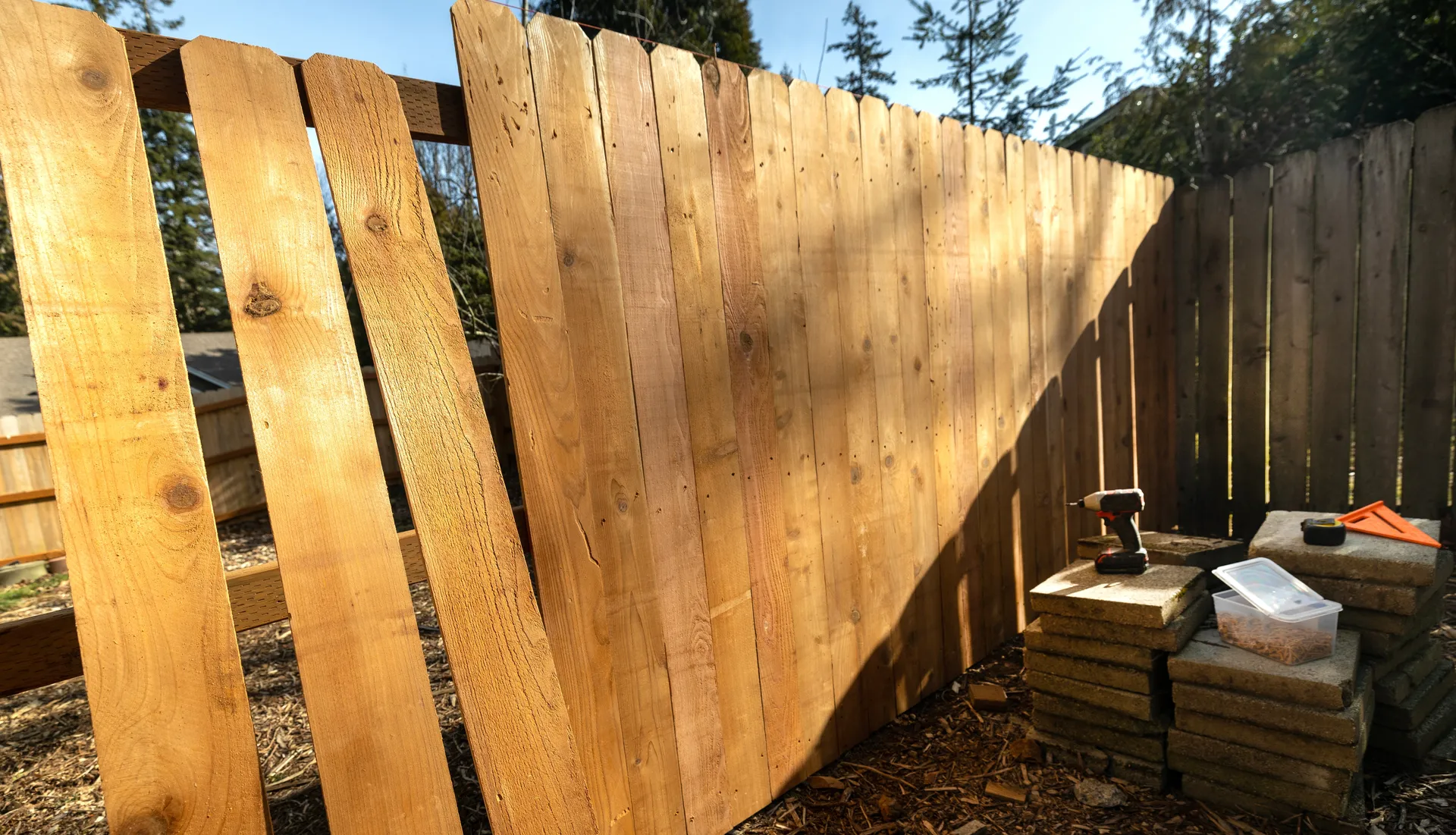
Minor warping (small bow or cup). Remove the nails and reattach the board with screws. Pull the board flat against the rail as you drive the screws in. In many cases, screws can pull a mildly warped board back close to flat. Use two screws per rail -- one near the top of the board and one near the bottom -- to maximize the pull.
Moderate warping (visible curve, but the board is still intact). Try soaking the board with water on the concave (cupped-in) side, then clamping it flat against a straight surface and letting it dry in the sun. This does not always work, and the board may warp again later, but it can buy you time if replacement is not in the budget yet.
Severe warping (boards twisted, popping off rails, large gaps). Replace the boards. There is no reliable way to straighten a badly warped fence board permanently. Pull the damaged boards off and install new ones. If you are replacing more than a few boards, consider upgrading to cedar or thicker pickets to prevent the same problem from happening again. Your local fence repair company can handle this quickly.
Top rail sagging and pulling boards out of alignment. Sometimes the problem is not the pickets but the rails. If the horizontal rails between posts have sagged or bowed, the pickets attached to them will look warped even if the individual boards are fine. In this case, you need to replace or reinforce the rails. Adding a tension wire along the top rail can also help pull a sagging section back into line.
When a Section Is Too Far Gone
If you have a full section of fence -- say 8 to 16 feet between posts -- where most of the boards are warped, twisted, or pulling free from the rails, it is usually cheaper and faster to replace the entire section rather than fixing boards one at a time. A fence repair crew can remove the old section and install new boards and rails in a few hours.
This is also a good opportunity to upgrade. If the original fence used thin pine pickets that warped within a few years, replacing with thicker cedar boards and proper sealant will give you a section that holds up much better going forward.
The Bottom Line on Warping in Charlotte
Wood fence warping is not a mystery. It is caused by moisture moving through the wood too fast and too unevenly, and Charlotte's summer weather creates exactly those conditions. The fix is choosing better materials, installing them correctly, and protecting the wood with sealant before the first hot season hits.
If your fence is already warped, minor cases can be fixed with screws, but severe warping means board replacement. A local fence contractor can assess the damage and tell you whether a repair or a partial replacement makes more sense for your situation.
The single best investment you can make in a wood fence in Charlotte is staining or sealing it within the first few months after installation -- and then keeping up with that maintenance every 2 to 3 years. That one step prevents more warping, cracking, and rot than anything else you can do. If you need warped boards replaced or a new fence built with the right materials, call to connect with a local contractor, or request a free quote online.