 Best Fencing Charlotte
One of the first questions Charlotte homeowners ask before building a fence is whether the neighbor has to split the cost. Maybe you both want a fence. Maybe only you do. Maybe the neighbor is all for it but does not want to pay anything. The question of who pays for a fence on or near the property line is one of the most common -- and most misunderstood -- issues in residential fencing.
Here is the short answer: in North Carolina, your neighbor is not required by law to pay for any portion of a fence you want to build. There is no state statute that forces cost-sharing. But that does not mean you cannot work something out. Most Charlotte homeowners handle this through conversation, not courtrooms. Below is a full breakdown of how the law works, how property lines factor in, and how to handle the situation practically.
North Carolina Has No Mandatory Fence Cost-Sharing Law
Some states -- California is the best-known example -- have laws that require both property owners to share the cost of a boundary fence equally. North Carolina is not one of those states. NC does not have a general fence cost-sharing statute for residential properties.
What this means in practical terms: if you want a fence and your neighbor does not, you pay for the whole thing yourself. Your neighbor has no legal obligation to contribute a single dollar. You cannot send them a bill, and you cannot take them to court to force them to pay half.
This catches a lot of people off guard, especially homeowners who moved to Charlotte from states with different rules. But in North Carolina, the law treats fencing as a private improvement. If you want it, you pay for it. For more on local fence regulations, see our Charlotte fence permit rules guide.
The Common Practice in Charlotte
Even though the law does not require cost-sharing, many Charlotte neighbors voluntarily split the cost of a shared boundary fence. This happens often in subdivisions where both homeowners want a fenced backyard and the fence runs along their shared lot line.
The typical arrangement looks like this: both neighbors agree on the fence material, height, and style. They split the cost 50/50 for the shared section. Each homeowner pays the full cost for any fence sections that do not border the other's property -- side yard runs to the house, gates, and so on.
This is a handshake deal in most cases. Some homeowners put it in writing, which is smart. A simple written agreement that states the fence style, total cost, each party's share, and who is responsible for future maintenance protects both sides and prevents arguments later. You do not need a lawyer for this -- a signed letter between neighbors works fine.
Building ON the Property Line vs. INSIDE Your Property Line
This is one of the most important decisions you will make, and it has real legal consequences.
If you build the fence directly on the property line, the fence technically sits on land that belongs to both of you. In North Carolina, this creates a situation where both neighbors have a legal interest in the fence. Neither neighbor can unilaterally remove it, modify it, or let it fall into disrepair without potentially being liable to the other. If you build on the line, you and your neighbor are essentially co-owners of that fence.
If you build the fence 2 to 6 inches inside your own property line, the fence is entirely on your land. It belongs to you. You control it, maintain it, and can remove it whenever you want. Your neighbor has no say in what you do with it because it is not on their property.
Most Charlotte fence contractors recommend building 2 to 6 inches inside your property line for exactly this reason. It avoids disputes about ownership, it keeps the post holes and concrete footings entirely on your land, and it gives you full control over the fence. The small amount of yard space you give up is worth the clarity it provides.
The one downside of building inside your line: your neighbor does not own any part of the fence, which means they have less incentive to help maintain it. If the fence faces their yard too, they benefit from it without any financial responsibility. That is a tradeoff you should consider before deciding where to place it.
How to Find Your Exact Property Line
Before you build a fence anywhere near the boundary, you need to know exactly where that boundary is. Guessing is a bad idea. Building even a few inches over the property line onto your neighbor's land can create legal problems, force you to move the fence, and damage the relationship.
Here are the three ways Charlotte homeowners find their property lines:
Mecklenburg County GIS maps. The county provides free online GIS (Geographic Information System) maps that show property boundaries, lot dimensions, and parcel information. These maps are useful for a rough idea of where your property lines are, but they are not survey-grade accurate. Do not rely on GIS maps alone for fence placement.
Survey pins. When your property was originally surveyed, the surveyor placed iron pins at the corners of your lot. These pins are usually buried a few inches below the surface at each corner of the property. You can sometimes find them with a metal detector or by probing the ground with a screwdriver at the approximate corner locations. If you find the pins, you can run a string line between them to mark the property boundary.
Hire a surveyor. A professional property survey in the Charlotte area costs $300 to $600 for a standard residential lot. The surveyor will locate the exact boundaries, mark them with stakes or flags, and provide a certified plat showing the dimensions. This is the only method that gives you legally defensible boundary information. If your fence project is $5,000 or more, spending $400 on a survey is cheap insurance against placing the fence in the wrong spot.
What If You Both Want a Fence?
This is the easiest scenario. You and your neighbor both want a fence along your shared boundary. Sit down together and discuss the details:
- Material and style: You both need to agree on what the fence looks like. A disagreement about wood vs. vinyl or 4-foot vs. 6-foot needs to be settled before anyone calls a contractor.
- Cost split: A 50/50 split on the shared section is the most common arrangement. If one neighbor wants a more expensive material, they might pay the difference.
- Contractor selection: Using one contractor for the whole project is simpler and often cheaper than having two separate companies work on different sides.
- Maintenance plan: Who stains the fence? Who pays for repairs? Decide this upfront.
Get the agreement in writing. Include the total cost, each person's share, the materials to be used, and who is responsible for ongoing maintenance. Date it and have both parties sign it. Keep a copy with your property documents.
What If Only You Want a Fence?
If your neighbor does not want a fence or does not want to pay for one, you are on your own -- which is fine. Here is how to handle it:
Build the fence 2 to 6 inches inside your property line so it is entirely on your land. You pay for everything. You own the fence. You maintain it. Your neighbor cannot stop you from building a fence on your own property (as long as you comply with local codes and any HOA rules).
As a courtesy, talk to your neighbor before the project starts. Let them know you are planning to build a fence, show them where it will go, and tell them when the crew will be on site. You do not need their permission, but giving them a heads-up prevents surprises and keeps the relationship friendly. This matters because you are going to live next to this person for years.
One question that comes up: can your neighbor attach anything to your fence -- a planter, a trellis, a hanging decoration? If the fence is on your property, no. It is your fence, and they need your permission to attach anything to it. Most neighbors will ask first, but if they do not, you are within your rights to ask them to remove it.
The "Good Neighbor" Practice: Which Side Faces Out?
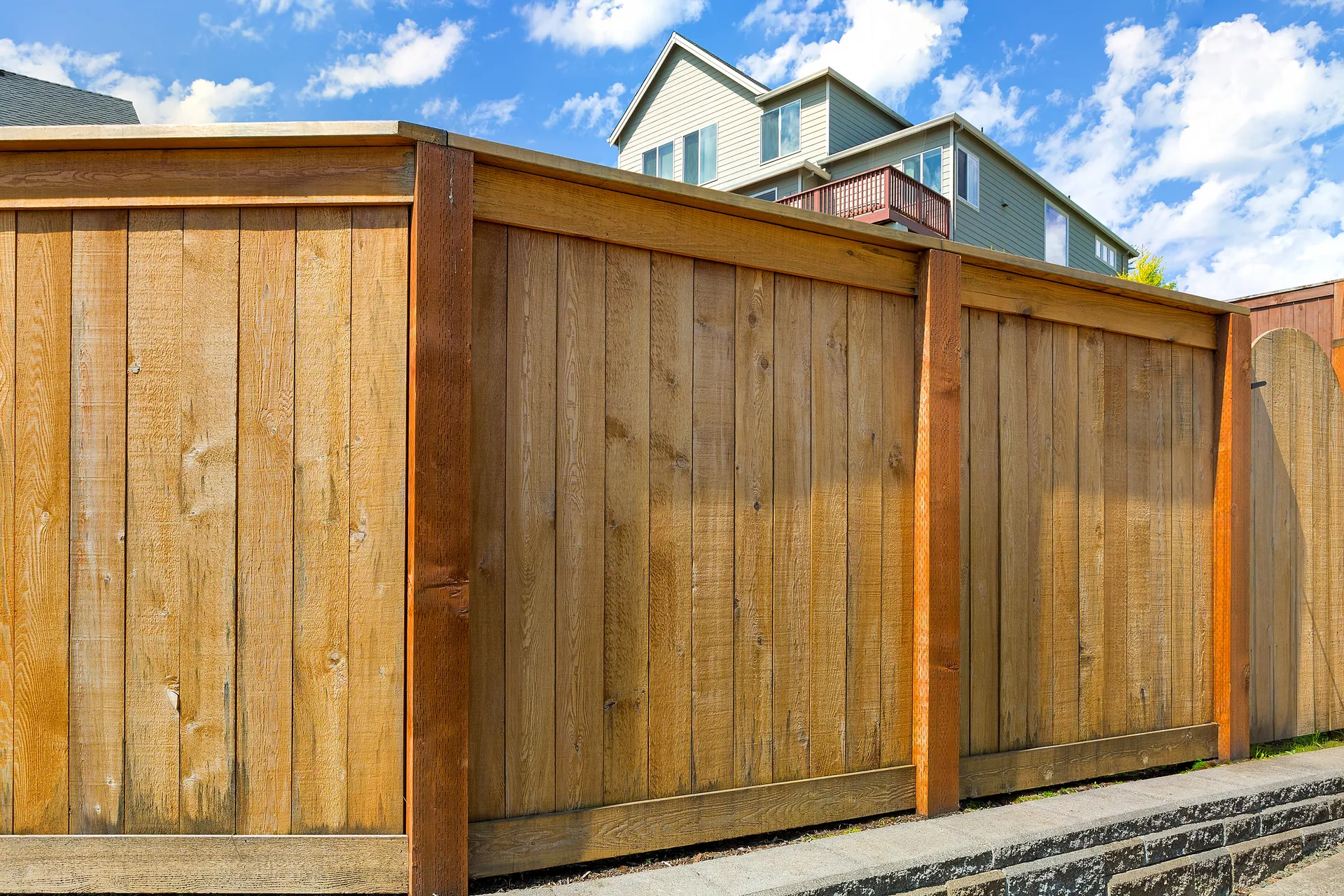
A standard privacy fence has a "finished" side (the flat, smooth side with the pickets) and a "structural" side (where the posts and rails are visible). Traditionally, the finished side faces outward -- toward the neighbors and the street -- while the homeowner who paid for the fence sees the posts and rails from their yard.
This is called the "good neighbor" rule, and many Charlotte HOAs actually require it. Mecklenburg County code does not mandate which side faces out, but most neighborhoods expect the finished side to face the public or the neighbor.
If you do not want to see the structural side from your yard, a board-on-board or "good neighbor" style fence looks the same from both sides. This costs slightly more -- about $3 to $5 per foot extra -- but it keeps both you and your neighbor happy with the appearance.
What If Your Neighbor Damages Your Fence?
If a neighbor damages your fence -- whether accidentally (backing into it with a mower) or deliberately -- they are liable for the repair cost if the fence is on your property. In practice, most damage situations are handled between neighbors without involving lawyers or courts.
If the damage is minor, a conversation usually resolves it. If the damage is significant and the neighbor refuses to pay, you can file a claim in small claims court in Mecklenburg County. Small claims court handles disputes up to $10,000, and you do not need a lawyer to file. Bring photos of the damage, a repair estimate from a fence repair company, and any documentation of the neighbor's responsibility.
If the damage was caused by a tree on the neighbor's property falling onto your fence, the situation is more complicated. In North Carolina, a neighbor is generally liable for damage from a dead or visibly diseased tree they failed to maintain. If a healthy tree falls during a storm, it is typically considered an act of nature and your homeowner's insurance would cover the repair. Document the condition of the tree (photos help) and contact your insurance company.
Easements and Utility Right-of-Way
Before building a fence near your property line, check for easements. An easement gives someone else -- usually a utility company -- the right to access a strip of your property for maintenance purposes. Common easements in Charlotte include:
- Utility easements: Typically 5 to 15 feet wide along one or more sides of your lot. Duke Energy, Piedmont Natural Gas, and Charlotte Water all have easements in residential neighborhoods.
- Drainage easements: Common in subdivisions with stormwater management systems. You cannot block the flow of water through a drainage easement.
- Access easements: Give a neighbor or the HOA the right to cross your property for specific purposes.
You can usually build a fence within an easement, but the utility company or easement holder has the right to remove your fence if they need to access the area -- and they are not required to pay for replacing it. This is a real risk. If your fence runs through a Duke Energy easement and they need to do maintenance, they will take the fence down and leave you to rebuild it at your own expense.
Your property survey or plat will show the location and width of any easements on your lot. Your fence contractor should account for these when designing the layout. For more on choosing a fence contractor who handles these details properly, see our guide.
Getting Written Agreements Before Building
If you and your neighbor are splitting the cost of a fence, put the agreement in writing. This does not need to be a formal legal contract. A simple document that includes the following is sufficient:
- Names and addresses of both property owners
- Description of the fence (material, height, style, color)
- Location of the fence relative to the property line
- Total cost and each party's share
- Who is responsible for maintenance (staining, repairs, eventual replacement)
- What happens if one party sells their home (does the agreement transfer to the new owner?)
- Signatures and date
Keep a copy with your property records. If you want extra protection, you can have the agreement notarized, but this is not legally required in North Carolina for a private fence agreement.
Practical Advice for Charlotte Homeowners
After dealing with property line fence questions daily, here is what experienced Charlotte fence contractors recommend:
Talk to your neighbor first, always. Even if you are paying for the whole fence and building it on your own property, a conversation before construction starts prevents misunderstandings and preserves the relationship. Most neighbors are reasonable when you approach them with a plan.
Build inside your property line. The 2 to 6 inches you give up is nothing compared to the clarity it provides. You own the fence. You control it. There is no ambiguity.
Get a survey if there is any doubt. If you and your neighbor disagree about where the property line is, do not argue about it -- hire a surveyor. The $300 to $600 cost is nothing compared to the expense of moving a fence that was built in the wrong place.
Put cost-sharing agreements in writing. Verbal agreements work until they do not. A signed document protects both parties and makes everything clear.
Check your HOA rules. Many Charlotte HOAs have specific fence requirements about material, height, style, and even which direction the fence must face. These rules apply regardless of what you and your neighbor agree to. Get HOA approval before you start.
Check for easements. A fence built in a utility easement might have to come down someday. Know where the easements are before you build.
Building a fence along a property line does not have to be complicated or contentious. Most of the time, it comes down to a simple conversation with your neighbor and a clear understanding of where the line is. Handle both of those, and the rest is just picking the right material and finding a good contractor. Call to connect with experienced Charlotte fence companies, or request a free quote online.