 Best Fencing Charlotte
You have decided on a wood fence for your Charlotte backyard. Good choice. But now the fence company is asking you a question you were not expecting: do you want shadow box or board-on-board? Both are popular styles in Charlotte neighborhoods, and from a distance they can look similar. Up close, the differences in construction, privacy, airflow, cost, and appearance are significant enough to affect your daily experience with the fence for the next 15 to 20 years.
Here is a clear breakdown of both styles so you can pick the one that actually fits your property, your budget, and how you use your backyard.
How a Shadow Box Fence Is Built
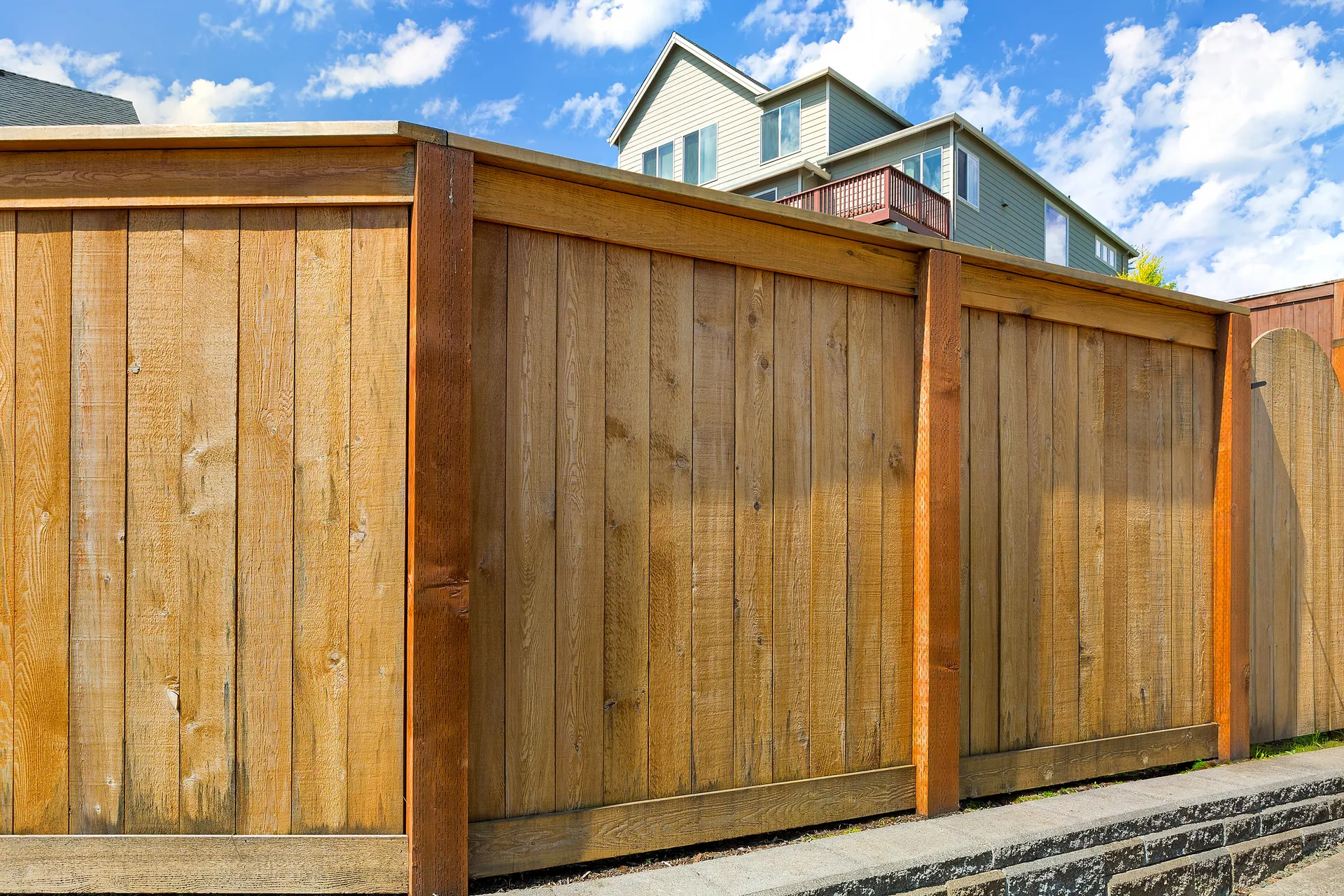
A shadow box fence -- sometimes called an alternating board fence or good-neighbor fence -- uses pickets attached to both sides of the horizontal rails, with the boards staggered so they overlap but do not touch. Picture it this way: on the front side, pickets are spaced with gaps between them. On the back side, more pickets cover those gaps, but they are offset so there is always a space between the front boards and back boards.
The result is a fence that blocks direct line-of-sight when viewed straight on, but allows some visibility at an angle. If you stand directly in front of a shadow box fence and look through it, you cannot see much. But if you walk along the fence and look at an angle, you can see through the staggered gaps.
The typical construction uses 1x6 or 1x4 pickets, with roughly 1 to 1.5 inches of space between pickets on each side. The pickets are nailed or screwed to two or three horizontal 2x4 rails that run between 4x4 posts. Because pickets are on both sides of the rails, the rails are hidden from view on either side of the fence.
How a Board-on-Board Fence Is Built
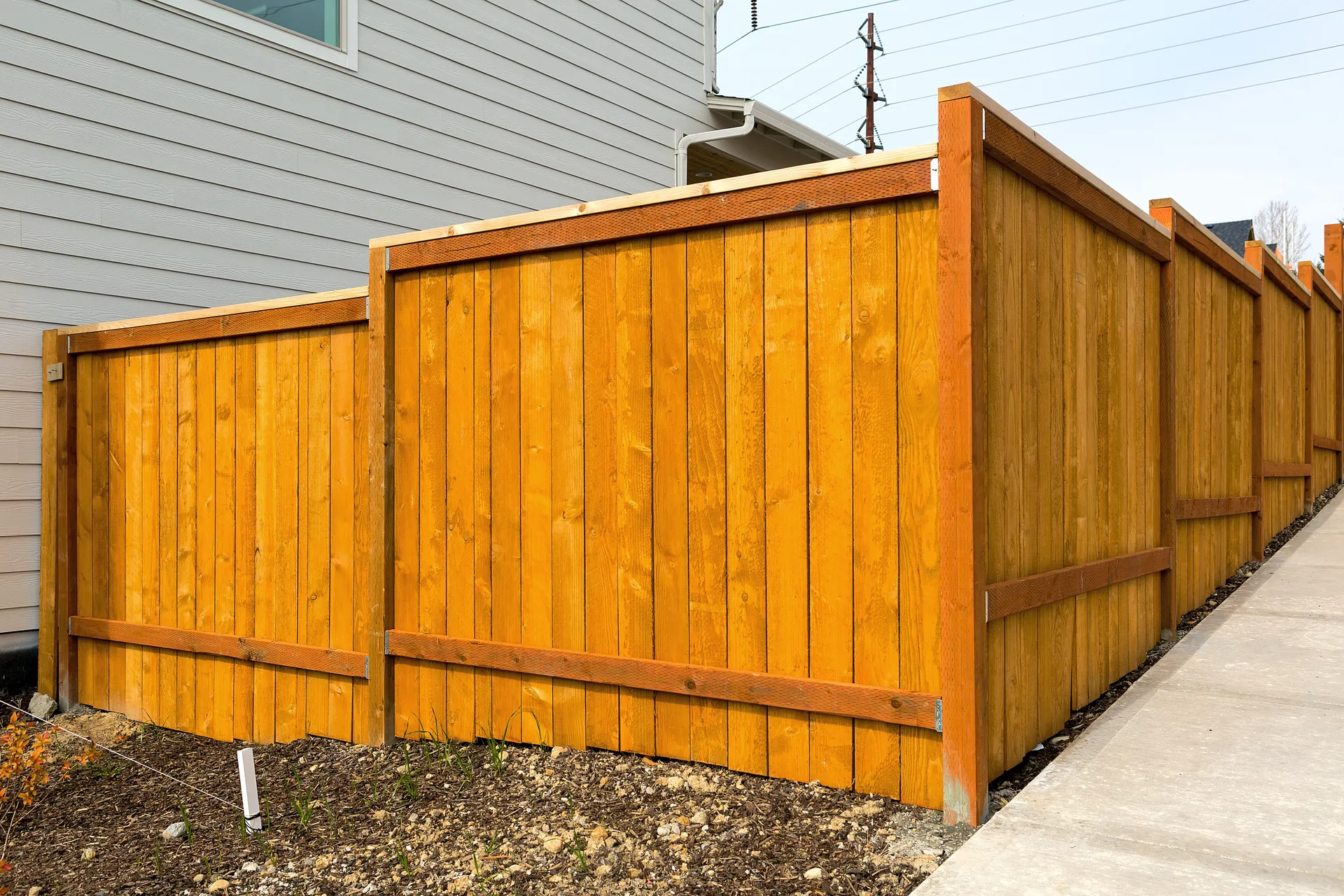
A board-on-board fence uses pickets on one side only, but the boards are overlapped so that each picket covers part of the one next to it. Instead of leaving gaps between pickets, each board is installed so it overlaps the edge of the previous board by about 1 to 1.5 inches. This creates a solid wall of wood with no gaps at all.
Construction is similar to a standard privacy fence -- pickets are attached to one side of horizontal rails that run between posts. The difference from a basic dog-ear fence is the overlap. On a standard privacy fence, the boards are butted edge to edge. On a board-on-board, they overlap, which means you use about 15% to 20% more boards per linear foot.
The rails and posts are visible from the back side of a board-on-board fence, just like a standard privacy fence. Only the front side presents the finished overlapping board appearance.
Privacy: How Much Can You Actually See Through?
This is usually the deciding factor for most Charlotte homeowners, so let's be specific.
Board-on-board provides full privacy. Because the boards overlap with no gaps, there is zero visibility through the fence from any angle. Standing right next to it or 50 feet away, you cannot see through it. If your primary goal is to block your neighbor's view of your backyard, your pool area, or your hot tub, board-on-board is the more private option.
Shadow box provides semi-privacy. From a straight-on view, a shadow box fence blocks most sight lines. But at an angle -- say, from a neighbor's second-story window or from someone walking along the sidewalk -- the staggered gaps allow partial visibility. You can catch movement and shapes through the fence, though you cannot make out details clearly. For many homeowners, this is plenty of privacy. For others, especially those with pools or in close-quarter neighborhoods, it is not enough.
If you are building in a neighborhood where houses are 15 feet apart, like many subdivisions in Huntersville and Ballantyne, the semi-privacy of a shadow box might not feel like enough. In neighborhoods with larger lots where the fence line is 30 or 40 feet from the neighbor's house, shadow box privacy is more than adequate. For more privacy ideas for Charlotte properties, see our article on privacy fence ideas for Charlotte backyards.
Airflow: Why It Matters in Charlotte
Charlotte summers are hot and humid. July and August average highs around 90 degrees with humidity that makes it feel like 100. Airflow through and over your fence affects how comfortable your backyard feels during those months.
Shadow box fences allow air to pass through. The gaps between the staggered boards act as vents. Wind can move through the fence instead of being blocked entirely. This is not a small difference. On a calm day you will not notice much, but when a breeze comes through, a shadow box fence lets that air reach your patio or deck. A solid fence can create a dead-air zone on the leeward side where heat and humidity just sit.
Board-on-board fences block airflow. Because there are no gaps, wind hits the fence and goes up and over it. Directly behind a solid board-on-board fence, air circulation drops noticeably. This also matters during storms. Charlotte gets strong thunderstorms and occasional remnants of tropical systems that bring sustained winds. A solid fence acts as a sail -- it catches the full force of the wind. A shadow box fence, because air can pass through the gaps, experiences less wind load. This means less stress on posts and rails, and less chance of the fence blowing over in a severe storm.
This wind-resistance advantage is one reason shadow box fences are popular in coastal areas, but it applies to Charlotte too. Those summer thunderstorms can bring 50 to 60 mph gusts, and a fence that lets some air through is going to handle that better than a completely solid one.
Appearance: The Good Side Question
Here is one of the biggest practical differences between these two styles, and it has nothing to do with privacy or airflow.
A shadow box fence looks the same from both sides. Because pickets are on both the front and back of the rails, both your side and your neighbor's side show finished boards. There is no "good side" and "bad side." This is why shadow box is sometimes called a good-neighbor fence -- nobody gets stuck looking at the bare rails and post backs.
A board-on-board fence has a clear front and back. The front shows the overlapping boards in a clean, finished pattern. The back shows the horizontal rails, the back of the pickets, and the posts. It is functional but not attractive. Many Charlotte homeowners default to putting the good side facing out (toward the neighbor or the street), which means they look at the back of the fence from their own yard.
Some HOAs in Charlotte-area neighborhoods require the finished side to face outward. This means if you choose board-on-board, the back of the fence faces into your own yard. If appearance from both sides matters to you -- and it does to a lot of people -- shadow box solves that problem automatically.
There is a workaround for board-on-board: you can add a cap rail and trim boards to dress up the back side. This adds $3 to $6 per linear foot in material and labor, but gives both sides a more finished look. Some Charlotte fence companies call this a "finished both sides" board-on-board. It is an option, but it narrows the cost gap with shadow box.
Cost Comparison
Both styles use similar materials -- the same posts, rails, and pickets. The cost difference comes from the amount of material used.
Shadow box fences use approximately 30% to 40% more pickets than a standard dog-ear privacy fence because boards are on both sides of the rails. In Charlotte, expect to pay $24 to $34 per linear foot installed for a 6-foot shadow box fence in pressure-treated pine, or $30 to $42 per linear foot in cedar.
Board-on-board fences use about 15% to 20% more pickets than a standard fence because of the overlap, but the pickets are all on one side. Installed prices in Charlotte typically run $22 to $32 per linear foot for pressure-treated pine, or $28 to $40 per linear foot for cedar.
On a 150-foot fence, the difference works out to roughly $300 to $750 more for shadow box, depending on the wood species and the contractor. The price gap is not dramatic, but it is real. For a detailed cost breakdown by material, check our cedar vs. pressure-treated pine comparison.
Which Style Do Charlotte HOAs Prefer?
HOA preferences vary widely across the Charlotte metro, but there are some patterns.
Shadow box is often preferred or required in neighborhoods where the HOA is concerned about the appearance of fences from streets and common areas. Because both sides look finished, shadow box satisfies the requirement for a "good neighbor" appearance without any additional trim work. Subdivisions in Ballantyne, South Charlotte, and many Weddington communities tend to favor shadow box for this reason.
Board-on-board is accepted in most Charlotte-area HOAs, but many require the finished side to face outward. Some HOAs also require a cap rail or trim on the back side to improve the appearance. Read your HOA covenants carefully before committing to a style -- the approval process can take 2 to 4 weeks, and you do not want to build the wrong style and be told to tear it down.
Some HOAs specify one or the other. A few newer subdivisions around Charlotte have architectural guidelines that name a specific fence style. If that is the case, the decision is already made for you.
Maintenance Differences
Both styles require similar maintenance -- staining or sealing every 2 to 3 years in Charlotte's climate, annual inspections for loose boards or damaged pickets, and occasional replacement of individual boards that crack or warp.
The one maintenance difference worth noting: shadow box fences use more boards, which means more individual pieces that can warp, crack, or come loose over time. On the other hand, because the boards on a shadow box fence are not touching each other -- there is always a gap -- each board can expand and contract with humidity changes without pushing against its neighbor. Board-on-board pickets, because they overlap, can bind against each other as the wood swells in humid Charlotte summers. This binding sometimes causes cupping or warping that you would not see on a shadow box.
In practice, both styles need about the same amount of ongoing maintenance. The differences are minor compared to the impact of wood species choice and whether you keep up with staining. For a full maintenance schedule, see our fence maintenance tips for Charlotte homeowners.
Best Wood Choices for Each Style
Both shadow box and board-on-board fences can be built with any of the common wood species used for fencing in Charlotte. But some combinations work better than others.
Cedar is an excellent choice for shadow box fences. Cedar boards are less prone to warping than pine, which matters on a shadow box where both sides are visible. A warped board on a board-on-board fence is partially hidden by the overlap. A warped board on a shadow box is visible from both sides.
Pressure-treated pine works well for board-on-board because the overlapping design is more forgiving of minor warping and the thicker appearance of pine boards gives the fence a solid, substantial look. Pine is also significantly cheaper than cedar, and since board-on-board already uses fewer boards than shadow box, the total material savings can be substantial.
Either wood works for either style -- this is about which combination gives you the best balance of appearance, performance, and budget for your specific project.
Which One Should You Pick?
Choose shadow box if: you want the fence to look good from both sides, airflow matters to you, your HOA requires a good-neighbor design, you are worried about wind resistance, or you share a property line with a neighbor and want to keep the relationship friendly.
Choose board-on-board if: full privacy is your top priority, you have a pool or hot tub that needs complete screening, you prefer the layered look of overlapping boards, or you want to spend slightly less on materials.
Both are solid fence styles that Charlotte contractors build every week. Neither is clearly "better" than the other -- it comes down to what matters most on your specific property. Talk to two or three local wood fence companies and ask to see examples of both styles they have built in the Charlotte area. Seeing them in person makes the decision much easier than looking at pictures.